Why trust this comparison
Statuo is built by Apdsoftware, an agency that has self-hosted everything for years. We know and respect Kuma: MIT-licensed, unlimited monitors, a polished UI. This comparison doesn't race on features — it has many, and good ones — but puts on the table the two costs the word "free" hides: your hours and the single vantage point.
What Uptime Kuma does well (genuinely)
A lot. It's free and open source (MIT), with unlimited monitors. It checks everything: HTTP/S, TCP, ping, DNS, keywords, Docker containers, databases. Intervals down to 20 seconds, 95+ notification channels, multiple status pages, 2FA, a UI in 20+ languages. Honest requirements: 1-2 vCPU and 1-2 GB RAM.
If you're a sysadmin monitoring your own infrastructure and admin time is part of the job, Kuma is probably the right choice. That's not irony: it's correct advice.
The two costs "free" doesn't show
The first is your time. Kuma must be installed, updated, backed up, secured and — the irony of monitoring — monitored: if the server hosting Kuma goes down, who tells you that you're blind? Add the VPS cost and the monthly maintenance hours, multiply by your rate, and "free" has found its price.
The second is structural: one instance is a single vantage point. Kuma watches sites from one place — your server — so a local network hiccup becomes a false "Down" (the project's own documentation explains how to diagnose "Down but it isn't"). Statuo confirms outages from multiple locations before alerting: when the alert fires, it's real. For an agency sending alerts to clients, the difference between a real alert and a false alarm is its credibility.
What matters to an agency
| What matters to an agency | Statuo | Uptime Kuma |
|---|---|---|
| Software price | From €29/month | Free (MIT), unlimited monitors |
| Server, updates, backups, security | Included: it's a managed service | On you (VPS + hours/month) |
| Who monitors the monitor | Redundant infrastructure, our responsibility | You: if your server dies, you're blind |
| Confirmation from multiple locations | Yes: no false alarms from local network | No: single instance, single point |
| Minimum interval | 1 minute | 20 seconds |
| Check types | HTTP/S (expected status codes, keyword, latency), SSL and domain expiry | HTTP/S, TCP, ping, DNS, Docker, DBs… |
| Notification channels | Email, Telegram, Slack and Microsoft Teams | 95+ |
| White-label status pages per client | Unlimited, your brand | Multiple, but branding is DIY |
| Custom domain with automatic SSL | CNAME and certificate on first visit, from the Agency plan | Manual setup (proxy, certs) |
| Built for reselling on subscription | It is the product | It's a tool, not a service |
| EU invoice with VAT handled | Yes (merchant of record) | Nothing to invoice |
Data verified in July 2026 on the Uptime Kuma project documentation (requirements: 1-2 vCPU, 1-2 GB RAM, 20 GB disk). The Statuo column was re-verified against the product on 19 August 2026. Uptime Kuma is MIT-licensed open-source software by its respective authors; no affiliation.
When to choose Uptime Kuma
- You monitor your own infrastructure and can administer it
- You need TCP, ping, DNS, containers and databases
- Admin hours are part of your job
- You want full control, on-premise
When to choose Statuo
- Monitoring is a service you sell, not a hobby
- A false alarm sent to a client costs credibility
- You want branded status pages without being a sysadmin
- You prefer a predictable fee to unpredictable hours
The self-hosting math, done honestly
A decent VPS for Kuma costs €5-10/month. Then: updates, backups, an eye on the logs, reverse-proxy certificate renewals, the day an update breaks something. Be conservative: one hour a month. At a €50/hour agency rate that's €55-60/month of real cost — twice Statuo Starter — for a system that watches from a single point and that nobody monitors.
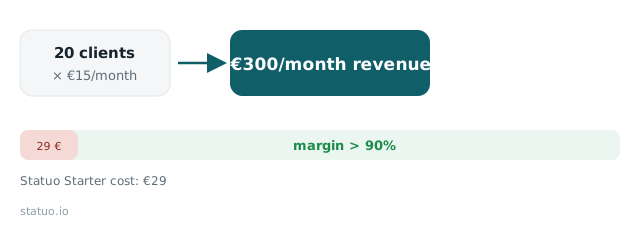
And that bill excludes the missed revenue: with Statuo, monitoring is a €15/month line on every client's retainer. Twenty clients means €300/month of revenue at 90%+ margin. Kuma you can use; a turnkey service to resell, you'd have to build.
FAQ
Uptime Kuma is free and has more features: why pay for Statuo?
If features are the yardstick, Kuma has more — we say so in the table. Statuo sells something else: the time you don't spend, multi-location confirmation that prevents false alarms to clients, and a white-label package ready to resell. You pay for a service, not software.
Can I migrate from Uptime Kuma to Statuo?
Yes, without friction: add your sites to Statuo (name and URL, nothing to install), keep Kuma running in parallel for a few days, create the client status pages, then switch off. The 14-day trial covers the overlap.
Does a single instance really cause false alarms?
It happens, and it's physiological: a local network issue on the server hosting Kuma looks identical to a site being down — the project's own documentation has an entry for "Down but it isn't". With multi-location confirmation, the alert fires only when independent points see the outage.
Does Statuo also check TCP, ping and databases?
No: Statuo focuses on websites — HTTP/S with expected status codes, a keyword in the page and a latency threshold, plus SSL certificates and domain registration expiry (from the Agency plan) — because that's what agencies resell to clients. For internal infrastructure monitoring, Kuma or similar tools remain the right choice — and the two can coexist.
What if Statuo shuts down? With Kuma at least I keep control
That's the right question for anyone self-hosting by definition. Your data (sites, check history, statistics) is always exportable as CSV/JSON from the panel, and stays available for 30 days even after cancelling: no lock-in. It's not the same total control as your own instance — but you're not left holding just an expired subscription.
If your time has a rate, you've already done the math
The first 10 agencies to activate a plan lock in a 50% lifetime discount and onboarding done together, site by site. The code is FOUNDING: you enter it at checkout, in the discount code field — if you find it already applied there is nothing to type, just check the 50% is in the total. When the seats are gone, they're gone.
No credit card. First site monitored in 30 seconds.